Recently in Old Ale Category

February Beer Club

| No Comments

Yeah, so I'm still running dry on beer puns. Fortunately, there's a pretty good chance you don't care about that, so I'll just explain that Beer club is a meeting of beer minded individuals from my work who get together for a meal and lots-o-beer once a month. It ended up being a rather small gathering this month, with just the core group showing up... and yet, plenty of fantastic beer was had by all.

Beer Club February 2013
(Click for bigger image)

Despite the less than ideal conditions, I'm going to record my thoughts on each sampled beer. For posterity! Yeah, the sip test is often unreliable, so take this with a giant boulder of gourmet sea salt, you nerd (he sez, as if it's a bad thing). Roughly in order of tasting (not necessarily the order in the above picture):

  • Samuel Smith's Organic Lager - Pretty standard Euro-lager affair here, though perhaps a higher quality version of such. Nice noble hoppiness and a surprising yeast character (nowhere near a Belgian strain, but it did add character to an otherwise normal beer). B
  • Eagle Rock Jubilee - One of my contributions for the night, or should I say, it's actually Jay's contribution, as this was part of our trade. I figured I shouldn't hog all of it to myself, though perhaps I should have, as this was reallly good. Smooth, creamy, spiced but not harshly so, this was a beauty. They call it a spiced old ale, but it feels a whole lot like a winter warmer and heck, let's just call it good beer. Beer Club crowd seemed mighty impressed as well. A-
  • Cisco Lady of the Woods - My other contribution, I liked it so much the first time, that I just had to share another with everyone else. I'm always surprised at how well received sour beers are by the Beer Club crowd, though perhaps I shouldn't be. I tend to call this beer club, but it originally began as beer and wine club, and this beer certainly has a nice Chardonnay character that turned some heads. Still an A by my reckoning...
  • Heavy Seas Black Cannon - One of them semi-local Maryland breweries, this wound up being a very solid black IPA. Beautiful nose, slight roasted malt character dominated by piney, resinous hops and maybe a bit of citrus. Alas, the taste didn't quite hold up, though again, still a very solid beer. B
  • Flying Fish Grand Cru Winter Reserve - Hoo boy, I hope you like clove, cause they must have packed this thing to the gills with cloves. Fortunately, I do like that, though the beer is pretty straightforward otherwise. B
  • Ommegang Three Philosophers - One of my long time favorites, just as good as ever. Fancy new label, too...
  • Heavy Seas Bourbon Barrel Aged Siren Noire - Holy chocolate milk, Batman! Seriously, like drinking slightly boozy yoohoo. Not getting much bourbon at all, though perhaps it's contributing to the almost creamy, vanilla character that goes so well with the chocolate flavors that dominate this beer. Really enjoyable and perhaps the most interesting beer of the night, if not exactly the best. B+
  • BrewDog Tokyo* - Another beer I've had before, this thing is a total monster. Clocking in at over 18% ABV, it's a pretty potent beer, though the solid malt backbone and addition of cranberries and jasmine help even that out a bit. Still a B+ in my book.
And with that, we had to cut things a bit short. A few sad beers were left unopened, but it was starting to snow and we didn't want to crack open that bottle of 14% Samichlaus (seriously, beer club compatriot Anthony brought Samichlaus and Tokyo*, which average out to somewhere around 16% ABV, pretty badass if you ask me. As a fan of older vintages of Samichlaus, I advised him to cellar this 2010 vintage until at least next Christmas and he seemed pretty excited about that prospect). So that just about covers it for this beer club. At the next beer club, my Fat Weekend IPA should be ready to go, so I'm pretty excited.

Cigar City Warmer Winter Winter Warmer

| 6 Comments

At some point, I resolved to get my hands on more Cigar City beers, and they do distribute to this area... but their offerings have been scarce of late. I have no idea why, but when I saw this one about a month ago, I quickly bought it, not realizing that it was from last year! It's a big, dark beer, so it should be able to hold up to the time, but it's also got a big hop component which I'm assuming I lost out on a bit. In any case, this beer officially kicks off the Christmas beer season. Here at Kaedrin, we take these things seriously, so expect to see a boatload of other wintery themed beers in the near future. This particular offering falls into the "make it stronger" school of holiday beer thought (with maybe a bit of "do whatever the hell you want", just for good measure.) The label sez it's a mashup of barleywines and old ale winter-warmer styles, but with a big citrusy American hop presence. They call it a Floridian Winter Ale:

Cigar City Warmer Winter Winter Warmer

Cigar City Warmer Winter Winter Warmer - Pours a very deep, dark amber brown color with a solid 3 fingers of fluffy head, good retention, and plenty of lacing. Smells full of caramel and citrusy, piney hops. Taste is very sweet, dominated by rich caramel, brown sugar, and toffee tones. Big citrus and pine hop flavors lighten things up a bit, but those sugary caramel/toffee flavors rule the day. Mouthfeel is full bodied, rich, and chewy, but very well carbonated, which really helps cut all the rich flavors a bit. That being said, there's a lot of mouth coating here, and a finish that lingers. Fortunately, these flavors are all right up my alley, so it works well enough in the end. The booze is well hidden in the taste, but you get that warming alcohol feeling in the belly soon enough. Overall, this is an interesting beer, along the lines of a barleywine or old ale, but kinda doing its own thing. A whole 750 gets to be a bit much, but I really enjoyed it. B+

Beer Nerd Details: 11% ABV bottled (750 ml capped). Drank out of a tulip glass on 11/23/12. Bottled November 2011 for consumption in 2011/2012.

I still haven't tried a lot of Cigar City's brews, but I'll be sure to snag a few the next time they make their way up here... Anywho, lots of Christmas, holiday, and otherwise wintery offerings coming up in the near future, even including a few deliberately aged brews. Stay tuned!

I've finally completed the cycle. Ola Dubh is a series of beers aged in different vintage Highland Park Scotch casks. I've already had four of the five available vintages, and they've ranged from the sublime to the merely great. Strangely, the "youngest" vintage was also the hardest to find (probably because it's the "cheapest", though it's still obscenely priced), but it also happens to be aged in the casks of one of my favorite "everyday" scotches, so I figured I should just go ahead and try both during the same session.

Harviestoun Ola Dubh 12 and Highland Park 12
(Click for bigger image)

Harviestoun Ola Dubh Special Reserve 12 - Pours a very dark brown with the slightest tinge of amber and a half finger of head. Big aromas of caramel, chocolate, and whisky, with some oak and vanilla and maybe even honey. The taste hits with a surprisingly peaty, smokey flavor right off the bat before settling into more typical caramel malt flavors. But that smoke is kinda ever-present, even in the finish and aftertaste. This is a little surprising given that I don't think of Highland Park as being a smokey peat bomb. On the other hand, while smokey, it's nowhere near as awkwardly balanced as beer aged in Islay Scotch casks, so there is that. But even this amount of smoke makes it harder for some of the more traditional chocolate and caramel flavors to assert themselves. Mouthfeel is medium bodied, a little thinner than expected, though there's obviously plenty here to chew on. Well balanced carbonation and it actually goes down pretty easy. Overall, this isn't a disaster or anything, but it is a bit of a letdown when compared to the others in the series, which are just much more balanced and complex. I'm still glad I tried some and it was enjoyable enough to warrant a weak B, but I'm again curious as to what a fresher bottle would taste like.

Beer Nerd Details: 8% ABV bottled (11.2 oz) Drank out of a snifter on 11/9/12. Bottle Number: 07449. Bottled in February 2010.

Highland Park 12 - Holy shit, I don't think I ever reviewed Scotch before. What do I do? I'll just pretend it's beer. Pours a golden light brown color with absolutely no head (uh, not that there's supposed to be, but come on, work with me here). Smells, um, like whisky. No, seriously, it's got a very light peat and smoke profile going on (though nothing that I'd think would lead to the smokiness in the aforementioned beer), along with some light caramel and honey, with that high octane, nose-singed alcohol note. Taste actually follows the nose, though some other notes emerge too. Light smoke and peat (again, not so much that I'd expect beer aged in these casks to be overwhelmed by it), some caramel, maybe a little graininess, some spicy character, and you know, booze. Mouthfeel is relatively smooth, with some of that spicy alcohol adding a little harshness. Overall, it's one of my go-to Scotches, it's got lots of complex flavors going on, but it's the complete package. Good stuff. I'll use my Scotch ratings scale. 4942 points.

Whisky Nerd Details: 43% ABV bottled (750 ml, 1 dram pour). Drank out of a Glencairn nosing glass on 11/9/12.

So there you have it. Not quite the face melting night I was hoping for, but enjoyable enough anyway. This more or less completes the cycle of Ola Dubh for me, unless Harviestoun starts sourcing more obscure Highland Park casks or something. Despite my thoughts on the 12 above, the rest of the series has been excellent enough that I'd love to try other vintages/specialty Scotch aged beers from Harviestoun. Speaking of the rest of the series, I think the final ranking of beers based on the vintage of the casks they were aged in comes down to: 40, 18, 30, 16, 12. Unfortunately, these things are obscenely expensive, especially when you hit the older vintages.

The Bruery Coton

| 2 Comments

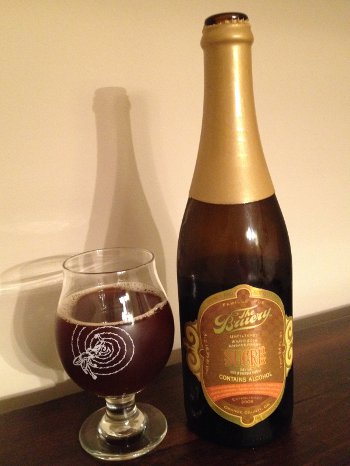
As a lowly beer neophyte reading raves about California's The Bruery on all the cool blogs, I made a pact with myself to hunt down some of their beer. This was the first thing I found, and I purchased it blind, price tag be damned. I had no idea what I was in for, but the label was pretty and it even had a fancy strip of tape covering the cap. The guy who sold it to me said "It's really good. Boozy, but good." Well, I drank it and my face melted. My original notes on this said it was very good but "maybe a bit too powerful". It was a real eye opener though. I'd never had anything like that beer before and it really pushed the boundaries of what I thought beer could be. It was a memorable experience and I can still recall the night vividly, right down the movies I was watching as I partook. I even saved up some shekels and bought another, with the thought that some of that booze would mellow out over time. And thus it's been burning a hole in my fridge for about 2 years now.

The Bruery Coton Label and Taped Cap

Coton was The Bruery's second anniversary ale, part of a series of beers named after traditional wedding anniversary gifts. The first anniversary beer was called Papier (French for "paper") and it was brewed in the style of an English Old Ale, but using The Bruery's house Belgian yeast strain. Coton uses the same recipe as Papier, but they blended a portion of Bourbon Barrel Aged Papier into the "young" beer to add complexity. The fancy shmancy term for this process is the Solera method. Each year, young beer is blended with previous batches, adding complexity and creating an older average age to the beer. The process is typically used in the production of wine and appears to be exceedingly rare in the world of beer. Aging beer is an expensive proposition for most breweries and a Solera project requires a great deal of foresight, ambition, and planning. Fortunately, The Bruery is clearly up to the task.

I've been purchasing these Anniversary beers every year, but truth be told, knocking back a 750 of 14.5% ABV beer takes something of a commitment. But it's been nearly two and a half years, I figured it was time to clear a few hours of the ol' schedule and bite the bullet on this thing. I've had beers that were rare or hard to get before, but this one weighed on me more than I expected, perhaps because it loomed so large in my mind. I know the general beer nerd consensus on this beer is mixed, but I have a personal connection with this beer that most don't share. It was a beer of firsts for me (first Bruery, among my first Barrel Aged brews, first time I broke the $20 barrier, and probably the highest ABV beer I'd had at the time, though I've long since surpassed that), and while I loved it the first time I had it, I'm always a little anxious about revisiting beers from that period.

Am I putting it on a pedestal? Will this hold up to my expectations? Well, I'm happy to report that it actually managed to exceed expectations... to the point where I'm even going to award it the vaunted Kaedrin A+ (only beer so far this year to earn that distinction).

The Bruery Coton

The Bruery Coton - Pours a deep dark amber (mahogany!) color with a sliver of light tan head. Smells strongly of brown sugar/molasses, dark fruits, and boozy bourbon with just a hint of oak and vanilla. Taste is very sweet, lots of that crystal malt character, rich caramel flavors, brown sugar/molasses, raisins and other dark fruits, even some spiced character, like cinnamon, and of course, that vanilla, oak, and bourbon killer combo. Big, complex flavors. Mouthfeel is full bodied, a little syrupy, but surprisingly drinkable. I don't want to call it thin, but it's not as thick and chewy as you'd expect for such a monster, and this is a very good thing in this beer, which has the potential to overwhelm, but never really does so. The carbonation is ample, which keeps this from feeling too syrupy and may help contribute to that drinkability too, keeping things smooth and almost creamy. It seems ridiculous to call a 14.5% ABV beer balanced, but it kinda is... The booze seems to have mellowed out with time as well, though I still get that warming alcohol feeling in my belly as I drink. This thing is drinking like a massive bourbon barrel, Belgian style barleywine, or something like that. It's exceptional, and it is kicking my ass tonight. A unique, complex, just all around superb beer, and it seems to have mellowed a little with time, which I think may have been for the better. I don't hand these out often, but this earns the coveted Kaedrin A+

Beer Nerd Details: 14.5% ABV bottled (750 ml capped and taped). Drank out of a goblet on 10/27/12. Bottled May 2010. Bottle Number 02592. 75% Ale, 25% Ale Aged in Bourbon Barrels.

So there you have it. I've got bottles of Cuir and Fruet (3rd and 4th anniversaries, respectively) in the cellar, and some other Bruery whales are incoming, so stay frosty folks. This is looking like a Bruery-filled, liver-destroying, wallet-lightening winter.

North Coast Old Stock Cellar Reserve

| 2 Comments

The concept of a "Stock Ale" is somewhat nebulous and laden with cultural and historical notions of brewing beer. Now, we're not talking saison-sized incomprehensibility, but it's not a very common style and the historical idiosyncrasies add complications. The term is often used interchangeably with "Old Ale" or even just "Strong Ale", and it is true that, historically, they are all somewhat related1. As you might guess, the distinguishing characteristics for such beers are also complicated and vague, but as luck would have it, I've already written about Old Ales before:

They're generally pretty high in starting gravity and relatively low in IBUs (sorta like an English Barleywine or a Scotch Ale), but they display a lower degree of apparent attenuation (meaning that there still a lot of residual sugars (dextrin) in the finished product). As the style name implies, these beers are also aged for a long period of time before distribution. This aging develops some interesting flavors along the lines of a lightly acidic, fruity malt character.

Now, the distinction between an Old Ale and a Stock Ale is that the latter, while featuring the same characteristics as the former, was not intended for direct consumption. Instead, brewers would blend the Stock Ale with young beer to establish that distinctive flavor base (you know, like chicken stock, but with beer!) This was particularly useful before the advent of refrigeration. Brewing during the summer was problematic at best, and usually resulted in infected or otherwise tainted beer. However, the cleverest among brewers figured out that freshly brewed summer beer could be "hardened" or "brought forward" by mixing it with older stocks of winter-brewed beer. If those old stocks survived the summer, they were then sold as Old Ale that next winter.

The advent of lager beer and modern refrigeration (among other unimportant things, like Prohibition and World Wars) has obviously decreased the need for "stock", but there are still a fair amount of old ales being made these days, and plenty of breweries still experiment with mixing aged and fresh beer2. North Coast makes one of the most popular current incarnations of old ales, called Old Stock Ale. What I drank last week was a Bourbon Barrel aged version of that beer, which is given the subtitle "Cellar Reserve" and fancily packaged in a beautiful, distinctive bottle, thus allowing them to charge through the nose for the stuff. And like a sucker, I paid through the nose, because I just can't resist stuff like this. It being beer that was originally made 3 years ago, I think I can let that slide a bit.

North Coast Old Stock Cellar Reserve

North Coast Old Stock Cellar Reserve 2009 - Pours a murky, muddy brown color with half a finger of quickly fading, big bubbled head. Huge Bourbon and oak notes in the nose; also caramel, toffee, vanilla, and even a little fruitiness. Taste follows the nose, lots of caramel and toffee with some dark fruity notes and a whole boatload of rich Bourbon and oak character. Lots of hot booze too, though I find that it's pretty well integrated with the rest of the brew. Mouthfeel is surprisingly well carbonated. Not effervescent or fizzy or anything, but ample carbonation that helps temper some of that rich, chewy nature (not that I don't like rich, chewy beers, this is just an interesting twist on the style). Full bodied and complex, with some alcohol warming going on. It's a sipper, but I mean that in the best way possible. Overall, this is an excellent beer. I don't know that it's worth the price tag (you can probably find something similar for half the price), but I'm really happy that I got to try it. It's something I might even seek out again, price be damned! A-

Beer Nerd Details: 13.16% ABV bottled (500 ml). Drank out of a snifter on 10/06/12. 2009 vintage.

I've already got me some of North Coast's Old Rasputin XIV, their most excellent Imperial Stout aged in bourbon barrels. That's another beer pretty much guaranteed to be drunk in the next couple months. These things certainly are pricey, but the beers are pretty darn good too.

1 - I should note that a key source for a lot of this history is Ray Daniels' book, Designing Great Beers. He's got a chapter dedicated to sussing out the distinctions and characteristics of this vague style, and he's clearly much more knowledgeable on the subject than I am, so if this rinky dink blog post interests you enough that you actually want to brew the stuff (and if you're an advanced homebrewer - the book was a bit too much for my amateur operation), he's got you covered.

2 - The example of blending experimentation in old ales that comes to mind is The Bruery's Anniversary Ales series (i.e. Papier, Coton, Cuir, Fruet), which represent blends of new beer with last year's anniversary ale. This is technically referred to as the solera method, but I'll leave that pedantry for it's own post someday (I should really get around to drinking/reviewing those bottles of Bruery Anniversary beer). I suppose I should also note that even traditional blending is still alive and well, one example being those wacky Rodenbach fellows.

Founders Curmudgeon

| No Comments

The Old Ale style is a somewhat nebulous one, and there's a lot of overlap with stuff like Strong Ale and Stock Ale (which are terms sometimes used interchangeably with Old Ale), but near as I can tell, there actually are a few distinguishing characteristics. They're generally pretty high in starting gravity and relatively low in IBUs (sorta like an English Barleywine or a Scotch Ale), but they display a lower degree of apparent attenuation (meaning that there still a lot of residual sugars (dextrin) in the finished product). As the style name implies, these beers are also aged for a long period of time before distribution. This aging develops some interesting flavors along the lines of a lightly acidic, fruity malt character. Historically, given the challenges with sanitation in olden times, there was almost certainly some of that funky Brettanomyces character that came through... however, I don't think most modern examples have that feature (unless specifically designated as such). I certainly didn't detect any funk in Founders' typically solid take on the style:

Founders Curmudgeon

Founders Curmudgeon Old Ale - Pours a hazy amber brown (copper?) color with a minimum of light tan head. Smells of bready malts with a dark fruity kick (perhaps from that aging and booze). Taste is very sweet, featuring lots of rich malt flavors of caramel (maybe a little vanilla) along with a pronounced fruitiness and some booze. Mouthfeel is rich and smooth, creamy, but with plenty of tight bubbled carbonation. This feels very much like a scotch ale, though it's also similar to the recently reviewed Otter Creek Anniversary strong ale... I didn't realize it, but apparently this was aged on new oak of some kind (details are a little sparse), which I think may have tempered some of the flavors, which could easily have been unruly or overpowering, but really weren't. Overall, it's pretty darn good. B+

Beer Nerd Details: 9.8% ABV bottled (12 oz). Drank out of a snifter on 7/21/12. 50 IBUs. Bottled 4/19/12.

As usual, Founders delivers. And of course I'd love to try Curmudgeon's Better Half, one of those impossible to find Founders Backstage series beers that was aged in Bourbon Barrels that were also used to age maple syrup (yum). Alas, I missed out on the release earlier this year... here's to hoping that they get around to making some more next year...

Another Dubhel Feature

| 2 Comments

Ola Dubh is a series of beers aged in Highland Park Scotch casks. There are 5 vintage of casks used for this purpose, 12, 16, 18, 30, and 40 years old. A while back, I cracked open the 16, which was very nice, and the 40, which was astounding. Today, I'm ticking off two more vintages, so huzzah for that!

Interestingly enough, Scottish distilleries are also huge beneficiaries of the secondary oak barrel market caused by the legal rules surrounding Bourbon. Part of the reason Scotch tends to be aged longer than Bourbon is that the oak is usually on it's second use at that point, and a lot of the easily captured flavors have already been stripped from the wood. Or something. I'm sure there's some Scotch that is aged on new oak too...

For the filmic side of this double feature, I watched a pair of Japanese films from little known director Yoshihiro Nakamura. He was a discovery from Fantastic Fest last year, but unfortunately, most of his work is not available in America. However, they have slowly been trickling over, and the two movies I watched are both available on Netflix. The Booth is an interesting, if a bit unremarkable thriller. It was one of his early movies, and it shows. It's not bad, per say, just not something I'm very enthusiastic about. On the other hand, Fish Story is a wonderful movie that I highly recommend. It's about how a punk rock song saves the world, which is about all I'll say about the movie, because the less you know, the better. One of my favorite recent discoveries, and it went quite well with the beery side of this double feature:

Harviestoun Ola Dubh Special Reserve 18

Harviestoun Ola Dubh Special Reserve 18 - I have to say, I really love the label design of all these beers, even the ones that don't come in fancy boxes like the 30 and 40. Pours a deep, dark brown color with a small cap of light brown head. Smells beautiful - tons of whisky character (not very Scotchlike though - no peat or smokiness), a little oak and vanilla and caramel, maybe just a hint of roasted malts in the nose. The taste has tons of that Scotch character, and unlike the nose, I'm getting a lot of peat and heather in the taste (not much in the way of smoke), along with a prominent oak character. There's plenty of that balancing malt character too, caramel and dark chocolate come through well, and maybe just a hint of that roasted malt flavor. Mouthfeel is surprisingly medium bodied; a light richness, but very easy to drink. Overall, very well balanced, complex brew, definitely better than the 16. A

Beer Nerd Details: 8% ABV bottled (11.2 oz.) Drank out of a snifter on 4/20/12. Bottle Number: 06270. Bottled in February 2009.

Harviestoun Ola Dubh Special Reserve 30

Harviestoun Ola Dubh Special Reserve 30 - Pours a little bit deeper and darker than the 18, with a bit more head too. Again, smells very nice, perhaps not quite as strong as the 18, but very well balanced aromas of whisky, oak, and caramel, with a little roast. Taste is very similar. Lots of Scotch, a little peat and oak, some caramel, plenty of chocolate character, and a hint of roast in the finish. Mouthfeel is a little fuller, but but that richness is about the same, and it's still very easy to drink. Overall, it's very good, but I find myself think that it's comparable with the 18, rather than being much better. Don't get me wrong, this is still a great beer, but tonight, the 18 was better. A-

Beer Nerd Details: 8% ABV bottled (11.2 oz.) Drank out of a snifter on 4/20/12. Bottle Number: 06942. Bottled in March 2009.

So, after trying four of the five varieties, I'd say the best was the 40, followed by the 18, then the 30, and finally, the 16. Now I just need to get my hands on the 12. Strangely, it seems to always be sold out whenever I see some of this stuff, perhaps because it's also the cheapest of the family (and this stuff really is expensive!) I also have to wonder how the age has impacted these bottles. Every bottle I've ever had has been from 2009, including the two varieties I had last year. Would a "fresher" 30 be better? Perhaps! I guess there's only one way to find out, eh?

The Whip

| 2 Comments
Back in March, we had a beer club outing at The Whip Tavern, an English style pub. At the time, it was a bit cold and pouring rain, so we resolved to come back later in the year and sit outside. Well, a few weeks ago, we did just that. England doesn't really have a reputation for great cuisine, but both meals I've had here have been really great. The first was Bangers and Mash, and it was perfect. This time around I had some delicious duck contraption. For whatever reason, it seemed like the taplist was a bit more limited this time around, but I still managed to get my hands on a few seasonals and interesting beers nonetheless. I'm going from my sparse Untappd notes and memory here, so take the following with a grain of salt (also no pictures - sorry):

  • Dock Street The Great Pumpkin - Another pumpkin ale, this one somewhat more subdued in the alcohol and spice departments, which isn't really a bad thing, but which also doesn't really set this apart from any other pumpkin ale. Pretty standard stuff, though certainly something I could drink a few of... B- (Beer Nerd Details: 5.5% ABV on tap. Drank out of a half-pint glass.)
  • Weyerbacher Harvest Ale - It's the time of year when hops are harvested and breweries grab a portion of fresh "wet hops" (normally hops are dried in order to preserve them) to make various hoppy styles (a practice that deserves a closer look on the blog at some point). This beer gave off a really fantastic hoppy aroma. It's a little on the earthy/grassy side, with just a little citrus peeking through. The taste was nice and bitter, with an almost spicy hop character to it. Perhaps this is just me buying into the hype, but it tasted fresh. It's not a face melter or a revelation or anything, but a well executed IPA. B (Beer Nerd Details: 6.2% ABV on tap. Drank out of a half-pint glass.)
  • Leavenworth Boulder Bend Dunkelweizen - Not terribly familiar with the style, but it was kinda like a stout mixed with delicate wheat flavors. I have to say, I didn't really care for it. No off flavors or anything, it just wasn't working for me. Perhaps the roasty flavors were the cause of my issue, but whatever. I didn't have a problem drinking or finishing it, and it was certainly more interesting than a macro, but still not particularly inspiring. C (Beer Nerd Details: 4.7% ABV on tap. Drank out of a half-pint glass.)
  • Theakston Old Peculier - I've always heard good things about this beer, but I must have gotten a bad bottle because I didn't care much for it and the flavors I got out of it don't seem to match up with much of the BA nerds' thoughts... I got a distinct apple aroma out of this, which is typically a sign of problems. I also got some raisins in both the aroma and taste. It wasn't undrinkable, but it wasn't particularly good either. D (though I may revisit it at some point). (Beer Nerd Details: 5.7% ABV bottled (12 oz). Drank out of a pint glass.)
  • Innis And Gunn Oak Aged Beer - I had this the last time I went to the Whip as well, perhaps because it goes really well with one of the desserts. This time around, I got a better feel for the oak and caramel/toffee flavors in the beer and was quite pleased that I got another. So I will up this to a B+ (Beer Nerd Details: 6.6% ABV bottled (11.9 oz). Drank out of a half-pint glass.)
  • Spaten Oktoberfestbier - I was going for a German Octoberfest beer; what I got was a skunked bottle of dishwater. Yes, it was in a green bottle, and it was bad. I couldn't get much out of this beer at all, and didn't finish it. This does kinda bring up the question of how to rate beers that are clearly defective, but in this case, it's all due to the green bottle choice, so I have no problem giving it an F. (Beer Nerd Details: 5.9% ABV bottled (12 oz). Drank out of a pint glass.)
Well, there you have it. Even considering that the drafts were mostly half-pints, I probably drank too much, but it was still a fun night out (we even stayed long enough to play a couple rounds of quizzo). I'm sure I'll be returning to this place at some point soon.

Categories

OpenID accepted here Learn more about OpenID

About

Hi, my name is Mark, and I like beer.

You might also want to check out my generalist blog, where I blather on about lots of things, but mostly movies, books, and technology.

Email me at mciocco at gmail dot com.

About this Archive

This page is an archive of recent entries in the Old Ale category.

Oktoberfest/Märzen is the previous category.

Pilsener is the next category.

Find recent content on the main index or look in the archives to find all content.